Diego Cibelli. A Life in the open air
Bilingual edition Ita/Eng
His repertoire is as fluid as his thinking. Diego Cibelli avidly absorbs everything his gaze rests upon, from everyday objects to Renaissance and Neoclassical engravings, from Darwinian drawings depicting aquatic microorganisms to plant and animal nature, from Greek and Etruscan art to fables, comedy, and mythological bestiaries. For him, creation is rêverie in action: a tool for direct knowledge of the world, an indispensable component of reason.
Born in Naples, after studying in Campania and Berlin he established his studio in Scampia. At the heart of a neighbourhood marked by unfinished utopias and the failure of rational urban planning, the idea of beauty as an act of resistance—an act of breathing amid chaos—took shape. For this reason, his art is a form of guerrilla practice, though one conducted according to its own rules, best understood by looking to both the recent and ancient history of porcelain, the material the artist has chosen for his work.
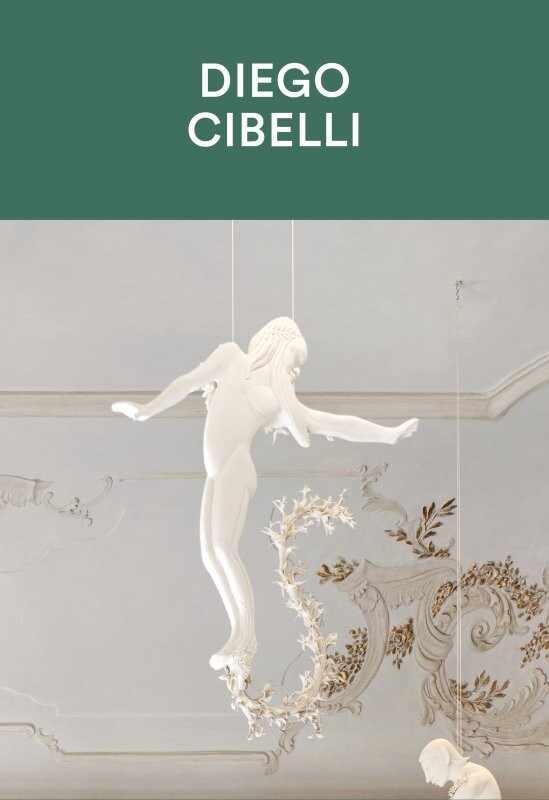
This publication is dedicated to the site-specific intervention Una vita all’aria aperta (A Life in the Open Air), created for the Fondazione Luigi Rovati Art Museum, where the works inhabit three distinct spaces: the palace atrium, featuring four masks inspired by Etruscan art; the entrance hall of the Piano Nobile, with four figures bearing ancient traits moving in a circular dance, suspended in mid-air, while a pair of birds on the wall stretches outward; and the large façade overlooking the garden, animated by reliefs of anthropomorphic figures, animals, and floral elements.
Cibelli favours the whiteness of biscuit porcelain, achieved through firing kaolin at extremely high temperatures, which allows him to model bodies and drapery with a marble-like appearance. He shapes ideas directly in clay and, through plaster moulds, gives life to forms that are both pristine and raw, destined to undergo the trial of fire. At once an emblem of resistance and fragility, porcelain in his hands becomes carnal, ironic, and popular. His figures and fragments are metaphors in which form is never entirely the same, nor ever entirely different: leaves, branches, faces, legs, and hands unfold and entice one another in a dance of pleasure, play, surprise, and life.